Energy Efficient Data Centers: Exyte focuses on sector coupling
Energy Efficient Data Centers: Exyte focuses on sector coupling
The rapid growth of the digital world has fueled a soaring demand for energy, driven largely by data centers. With cutting-edge technological solutions, Exyte is leading the way in managing and mitigating this challenge. By tailoring designs and technology to local conditions and specific client needs, Exyte develops and delivers some of the industry’s most advanced and sustainable data centers.
“Our mission is to design and build data centers that are not only efficient and sustainable but also ready to meet future challenges, all while reducing the technology sector’s ecological footprint,” says Manfred Engelhard. As the Director of Technology for Exyte’s Global Business Unit Data Centers, he continuously explores innovative technologies, such as liquid cooling, to reduce energy consumption and drive a greener future. Data centers require cooling because their computer chips generate significant heat, making efficient cooling systems essential for more sustainable operation.
What sets Exyte’s data centers apart is their ability to combine a range of customized solutions. “We work closely with our clients to assess the potential of integrating diverse energy systems and sources at different locations,” Engelhard explains. Feasibility studies consider a variety of factors, including the availability of renewable energy, ambient climate conditions, grid infrastructure stability, and land use for future expansion. This ensures that each project is uniquely optimized for sustainability and efficiency. Exyte also consistently explores options for utilizing the waste heat from data centers for district heating purposes and has already planned to implement this at several locations.
Sector Coupling Simplified
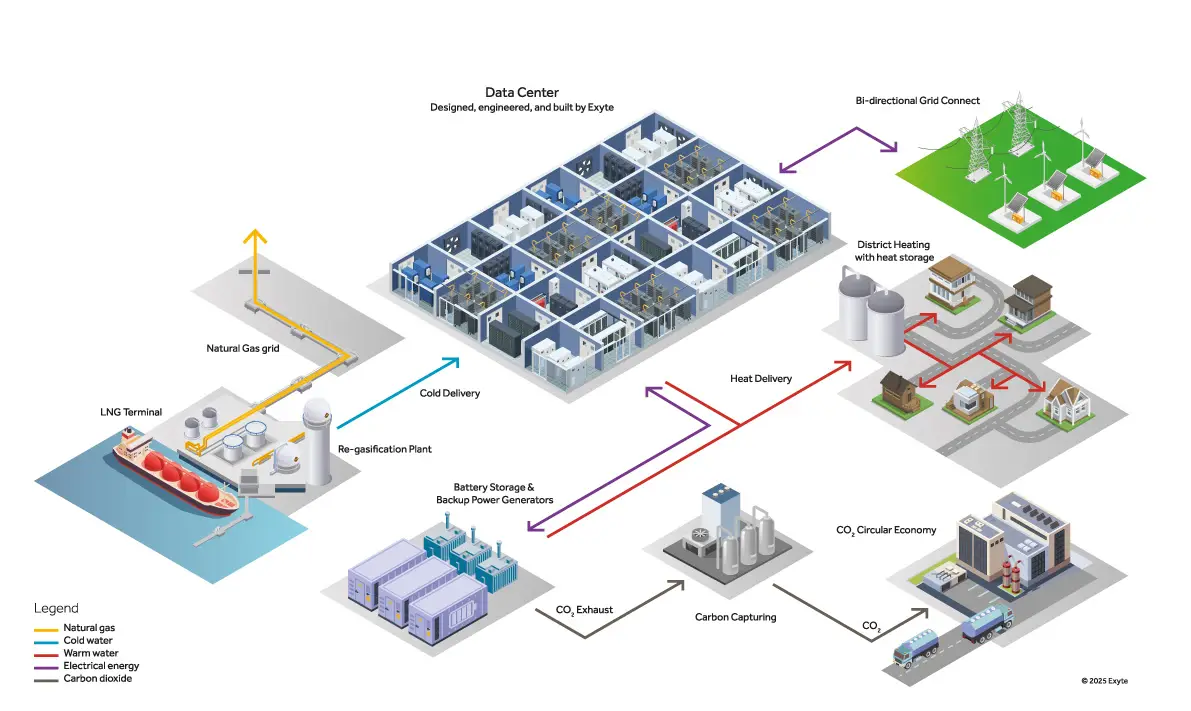
In an ideal scenario, a data center can serve as a cornerstone of the surrounding energy infrastructure, optimizing the use of available energy sources through efficient sector coupling. By customizing designs and technologies to local conditions and client requirements, Exyte creates and delivers some of the most advanced and sustainable data centers in the industry.
Capturing cold energy at the source
Engelhard and his team have conducted a concept study for an innovative project in collaboration with a partner company in Asia. Their ambitious plan is to design and build a large modern data center near the harbor of a major urban center equipped with a liquefied natural gas (LNG) terminal.
The idea behind this project may seem simple, but it requires significant engineering prowess and expertise. When LNG is regasified from its liquid state back to its original gaseous form, cryogenic energy is released. This process generates intense cold that is captured and directed into the data center’s cooling infrastructure. Heat exchangers are used to transfer the cold energy from the LNG to the cooling systems, effectively minimizing the need for additional energy to cool the data center.
Utilizing this energy resource, which is often just wasted, significantly enhances the sustainability and efficiency of the data center. “This is an ideal solution for coastline urban centers with LNG terminals. While we cannot employ this everywhere, this example shows that there are always opportunities to look for and identify energy sources and use them as efficiently as possible. Capturing this cold energy directly at the source enables our clients to reduce the environmental impact of their data centers. Every project that optimizes energy sector coupling helps.”
Data centers supporting local power infrastructure
Looking ahead, Engelhard envisions another innovative concept for future data center projects focused on carbon capture and utilization. The plan involves using a fuel cell system or gas engines powered by a blend of natural gas and a variable portion of hydrogen to generate electricity for the data center.
This concept is particularly well-suited for areas where the existing electrical grid cannot accommodate large additional consumers, such as major data centers. Examples of such areas are large European urban centers like Berlin, Frankfurt am Main, and Dublin that have a stable but strained energy grid, leaving limited capacity for substantial new demand.
Moreover, the infrastructure of data centers, which includes generators and batteries, can support the grid by providing control power on demand from the grid operator. Through bi-directional power connections, data centers can offer frequency control and voltage stabilization, contributing to overall grid stability.
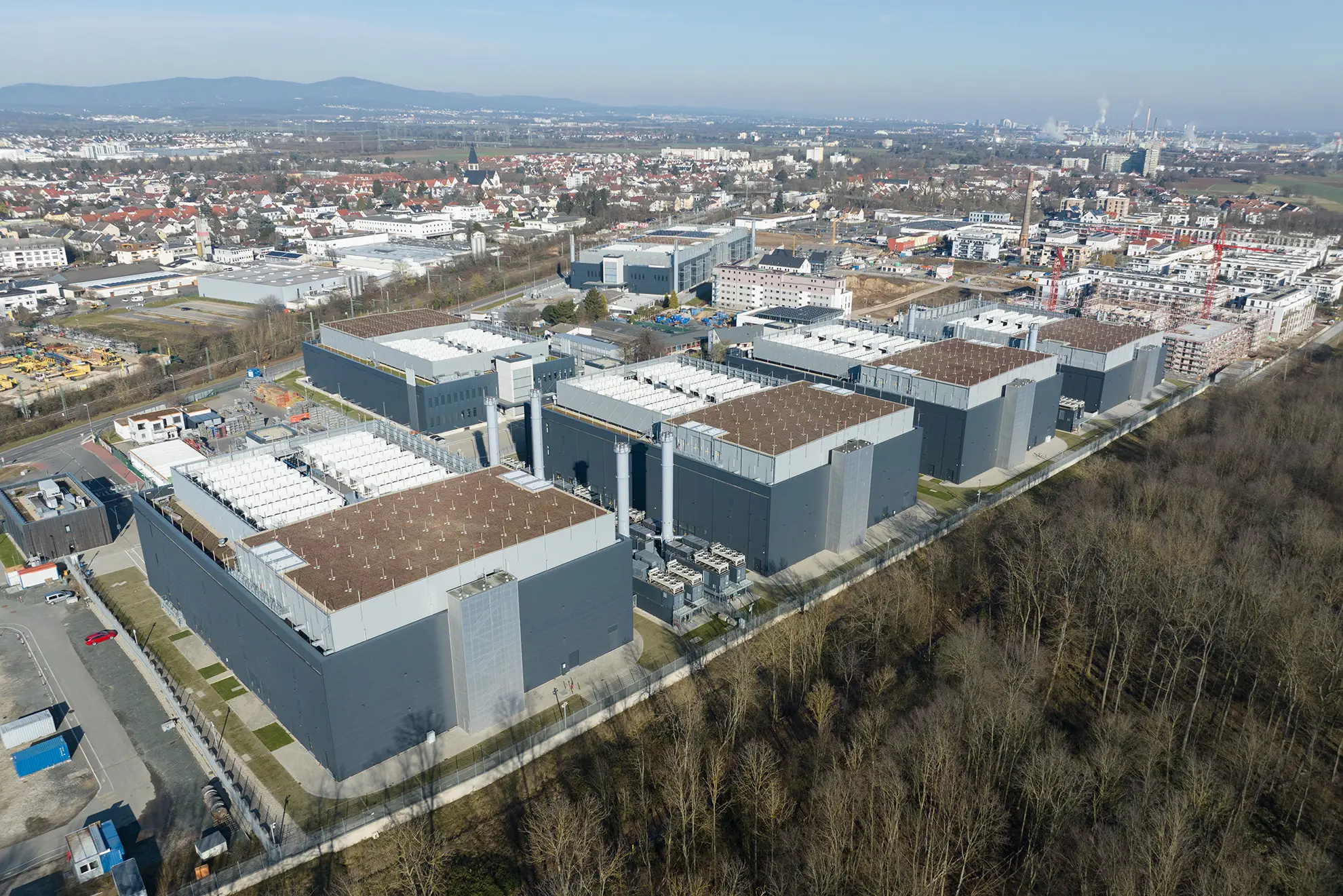
Data Centers in residential areas can repurpose waste heat through a thermal storage system to efficiently heat nearby homes, supporting sustainability in the community.
Exploring carbon capture for more sustainable data centers
“When you use natural gas for a fuel cell or gas engine, it releases carbon dioxide, or CO2, as a byproduct,” Engelhard explains. “Instead of letting the CO2 escape into the atmosphere, we can utilize carbon capture technologies and repurpose the carbon for industrial or food and beverage applications.” The captured CO2 can be re-used as an input material for producing various industrial elements, including carbon fiber, which is used in the manufacturing of lightweight components such as wind turbine blades. CO2 is also needed to produce synthetic fuels in combination with green hydrogen to support a more sustainable transportation sector.
“Engelhard highlights the potential: “By integrating a system like this, we’re not just powering the data center but also actively contributing to a circular carbon economy. It’s an exciting concept that merges sustainability with innovation, paving the way for greener, more efficient data centers.”
What is carbon capture and how does it work?
Carbon capturing in data centers involves capturing CO2 emissions produced by data center operations that are powered by a mix of natural gas and hydrogen. The CO2 is captured using chemical solvents or physical adsorbents. Once captured, the CO2 is compressed and transported via trucks to industrial sites. There, it is used in various industrial processes, such as producing chemicals, fuels, or building materials. This approach aligns with the principles of a circular carbon economy, where CO2 is reused rather than stored.

and transport

carbon economy