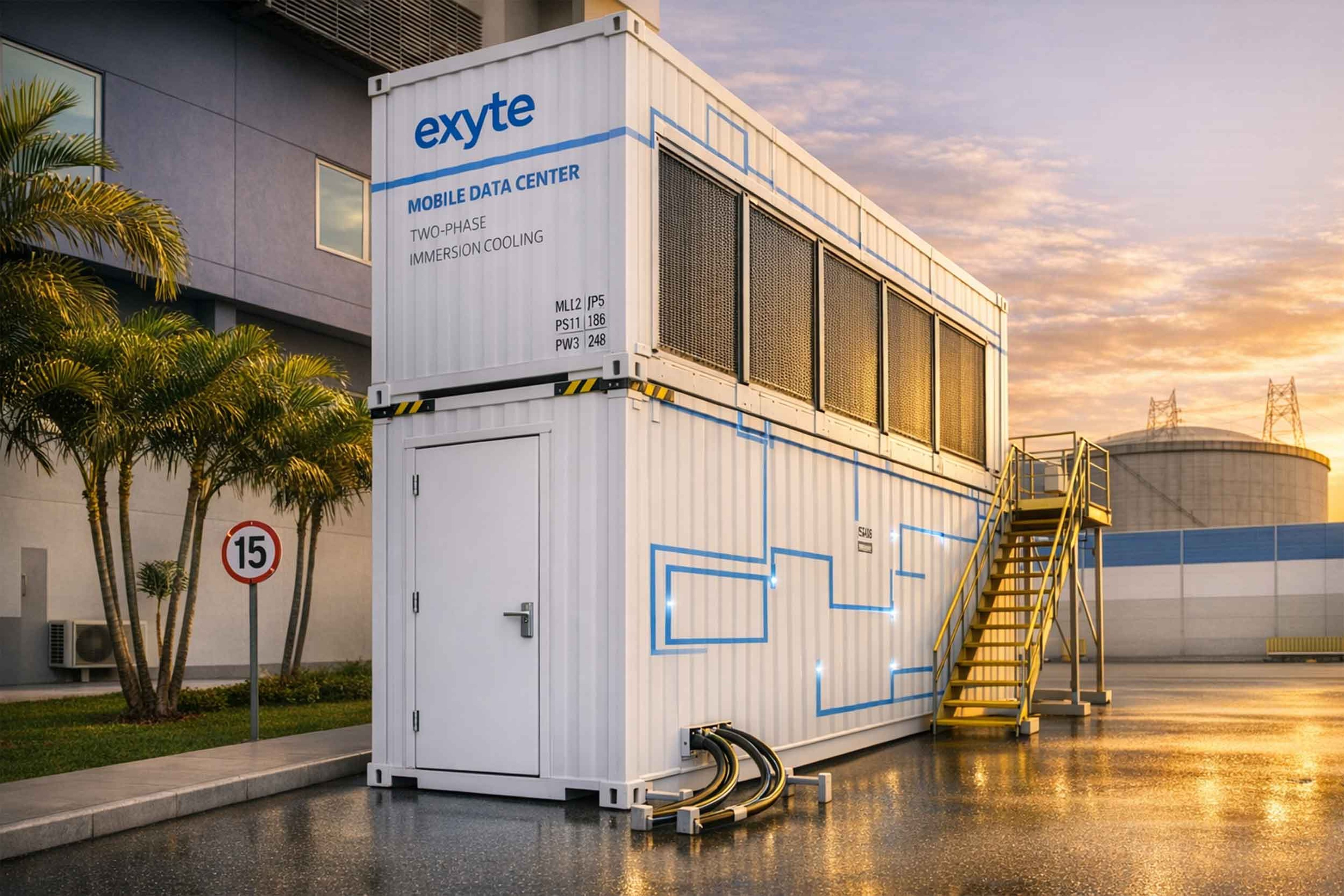
Modular construction methods are becoming increasingly important as demand for computing capacity accelerates. Two-phase immersion cooling further increases efficiency by enabling higher computing densities and reliable performance even in demanding climates. The concept has already proven itself in a rigorous field test under tropical conditions and is currently being refined further in Germany.

Sam Harris, Senior Manager Offsite Manufacturing Data Centers
As digital infrastructure expands, use cases such as real‑time analytics, artificial intelligence (AI) model training, edge computing for connected vehicles, and rapid scientific simulations require new computing power as fast as possible. “Modular data centers shorten deployment timelines and enable computing capacity to be added wherever it is needed,” Sam Harris, Exyte’s Senior Manager Offsite Manufacturing Data Centers, explains. Mobile units are part of this development because they bring high-performance computing (HPC) to locations where permanent structures cannot be completed fast enough or are not feasible at all.
As a proof of concept, Exyte engineers have developed a mobile data center with two-phase immersion cooling. “While the proof of concept does not aim to address every scenario directly, it shows Exyte’s capability to design and manufacture fully integrated data center modules, complete factory commissioning, and ship them ready for deployment,” Harris says. The concept combines a compact two‑container layout that can be transported with standard logistics and an advanced two‑phase immersion cooling system.
Manfred Engelhard, Director Technology Management Data Centers
A modular design built for mobility
The mobile data center consists of two transportable, standardized containers that are stacked on top of each other. Together, they are designed for an IT load of up to 1.5 to 2 megawatts in Nordic climates, and up to 1 megawatt in tropical climates. 1 MW of IT load means the power is available solely for servers and other computing hardware. This is roughly the power needed to supply around 1,500 average households with all their typical electricity demand.
“What makes this solution unique is the integration,” Engelhard explains. “We combine two‑phase immersion cooling with a modular, fully transportable cooling-generation system. To our knowledge, this combination has not been built by anyone elsewhere in this form.”
What is two‑phase immersion cooling?
Two-phase immersion cooling works by boiling a nonconductive liquid at a low temperature and recondensing the vapor, creating a highly efficient passive heat-removal cycle.
Compared with traditional air‑cooled systems, this approach reduces energy use, supports higher computing densities, and eliminates the need for complex air‑handling equipment. Exyte’s design avoids chillers through indirect free-air cooling. So far, two‑phase immersion cooling has not been available in mobile data centers.
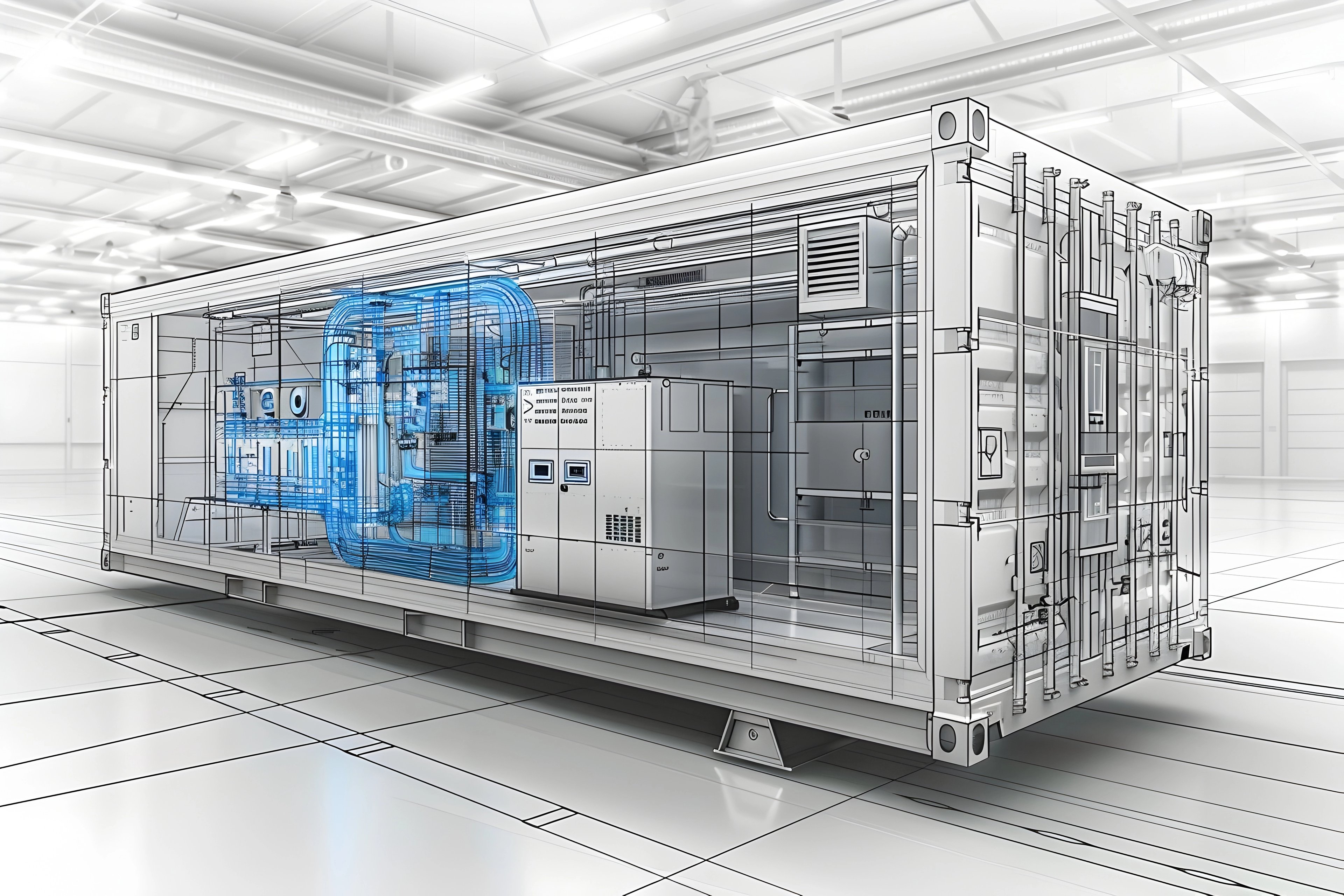
Exyte integrates the entire system directly into the container, resulting in a compact setup that needs less space on site and is easier to be deployed. “In short, our unit operates chiller-less, water-free, and with excellent power efficiency,” Engelhard says. This makes the system suitable for regions where water is scarce and avoids the additional investment and operating costs normally associated with conventional chiller installations.
Demonstrating performance under tropical conditions
The testing phase in Singapore focused on validating the thermal performance of the system under challenging environmental conditions. The unit includes two 500‑kilowatt immersion tanks, manufactured by Germany-based partner, Wieland, and a roof‑mounted cooling module that integrates heat exchangers, pumps, pipework, and large air‑cooling coils into a single structure.
The unit was field-tested in Singapore at a 1MW load in 33°C direct sunlight. It achieved a power usage effectiveness (PUE) of approximately 1.07, and in cooler 27°C conditions around 1.03 – far below the typical ~1.5 PUE of mobile air cooled systems in similar climates. These would typically need well over 50 percent extra power, because air cooling becomes less efficient as temperatures rise. “Our results confirm that the cooling concept performs as calculated, even under tropical conditions,” Engelhard says.
Use cases and opportunities
The mobile data center is ideal for rapidly adding computing capacity in locations where permanent facilities are too slow, too costly, or physically constrained. This makes it especially valuable for legacy data centers that cannot host modern AI/HPC hardware. By placing immersion‑cooled HPC capacity next to the existing building and connecting it to the IT network, clients can run new workloads without major retrofits.
Typical short-term needs include temporary capacity during rebuilds, research computing for limited periods, and deployments in remote or industrial locations. Additional applications include government and civil protection use cases, for example during natural disasters, and media operations at temporary event sites. Looking ahead, mobile data centers may also support distributed edge computing for autonomous driving systems.
From concept to commercialization
With the successful proof of concept completed, Exyte is now in discussions with potential clients, with commercial production of the proof of concept, or other modular data center solutions, as the next logical step.“We have validated our capability to design, build and commission cutting-edge data center modular technology through our global offsite manufacturing network. We are now actively collaborating with our clients to bring these solutions into commercial application,” says Harris.
OSM: turning off‑site manufacturing into real‑world results
Off‑site manufacturing is reshaping how complex, high‑tech facilities are delivered. By combining early engineering expertise with modular and prefabricated solutions, Exentec helps clients reduce risk, improve safety, and accelerate schedules. From data centers to other mission‑critical environments, this approach shows how OSM moves beyond a buzzword and becomes a practical tool for faster, more predictable project delivery.
Across high‑tech manufacturing, data infrastructure and life sciences, Exyte works at the point where ideas meet reality. Engineering what’s next means translating emerging technologies into environments that operate reliably and adapt to changing requirements. It is about creating solutions that are ready for what clients need now, and resilient enough for what they will need tomorrow.