Engineering sustainability into semiconductor manufacturing
Engineering sustainability into semiconductor manufacturing
Modern semiconductor fabs are being built at a time when environmental performance carries equal weight to the speed and scale of capacity ramp up. Semiconductor fabrication is among the most energy and re-source intensive industrial processes, making sustainability a driver of long term resilience and competitiveness. In this article Padmaja Ekambaram, Sustainability Manager at Exyte shares how a design led approach focused on aspects such as early engineering choices and circular principles can embed low carbon performance into semiconductor facilities from the outset, delivering lasting environmental and operational benefits.
Designing for a low carbon future
Low carbon facility design extends beyond improving operational efficiency. It requires a holistic approach that considers embodied carbon, material selection, spatial planning, utilities configuration, and adaptable building design for long term needs. Circular economy principles play a central role in this approach by shifting the focus from linear build and dispose models toward designing facilities that minimize waste, extend asset life, and enable reuse wherever possible.
“In semiconductor manufacturing, sustainability outcomes are largely determined long before a facility goes into operation,” explains Padmaja. “Early design decisions, how utilities are configured, how materials are selected, and how waste streams are managed, lock in environmental performance for decades. That is where the biggest opportunity sits.”
At Exyte, this thinking translates into deployed engineering solutions that prioritize measurable impact and long term operability. Beyond electrical and cooling efficiency, one of the most critical levers is reducing direct (Scope 1) process gas emissions from etch and chamber clean operations.
A key approach is the integration of greenhouse gas (GHG) abatement into the overall exhaust concept, such as a centralized abatement system designed to treat high global warming potential perfluorocarbons (PFCs) at scale, providing a robust alternative to traditional point of use systems and enabling more efficient operation and maintenance planning.
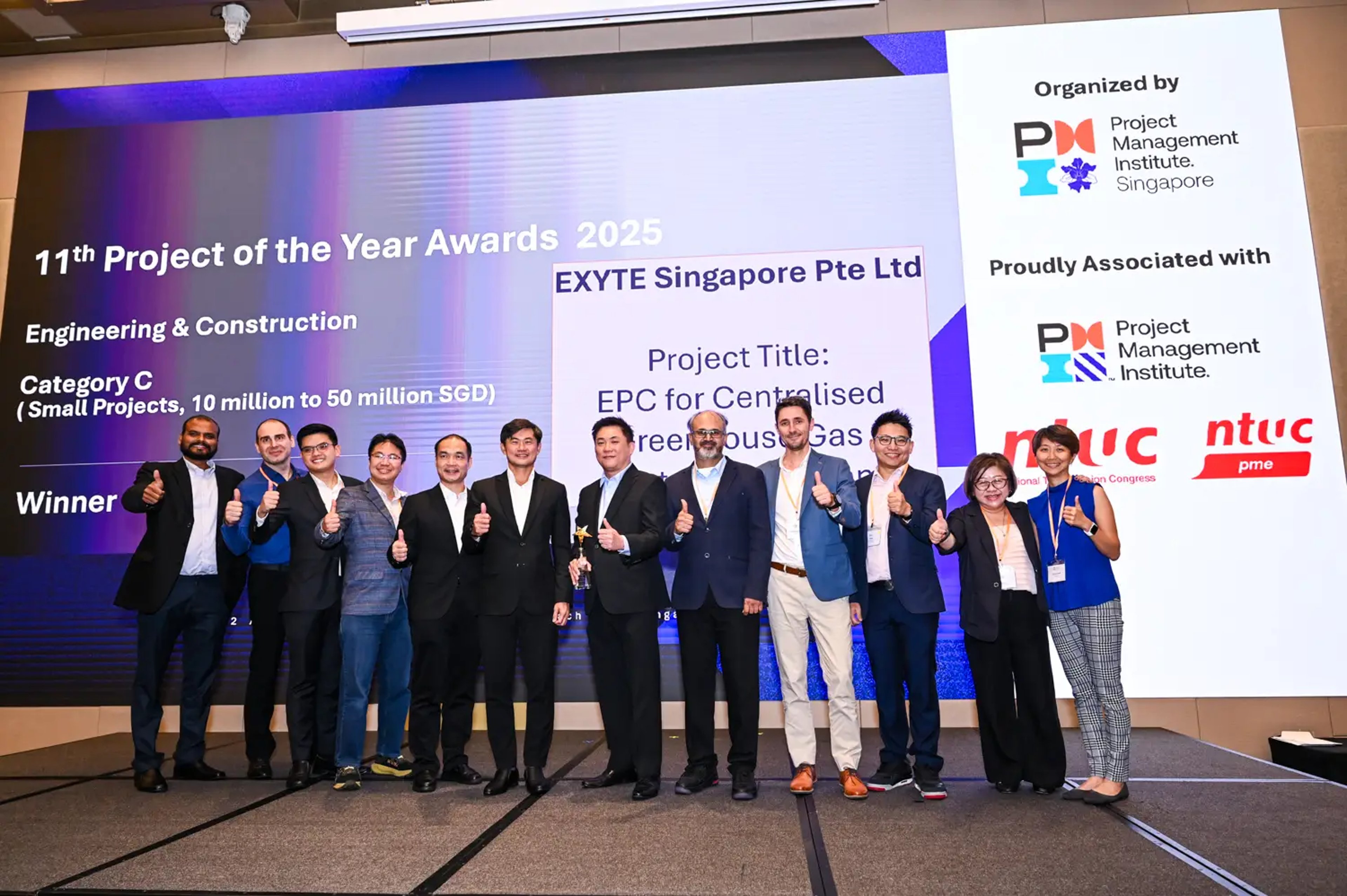
This was demonstrated by the successful delivery of Singapore’s first centralized greenhouse gas abatement system on a live semiconductor fabrication facility, which reduces PFCs emissions by about 95 percent and won Gold at the Project of the Year (POY) Awards 2025 by PMI Singapore Chapter.
Decarbonizing fab utilities through integrated design
Utilities systems account for a significant share of a semiconductor facility’s environmental footprint. Power distribution and cooling infrastructure are major contributors to electricity demand, while process gas exhaust management and abatement systems are critical for reducing direct greenhouse gas emissions from manufacturing.
Designing for decarbonization therefore requires balancing efficiency with reliability. Early stage engineering enables the evaluation of different utility configurations, redundancy strategies, and energy saving concepts before construction begins.
Padmaja adds: “Exyte employs virtual commissioning and digital twin technologies to simulate, integrate, and optimize utility system performance digitally before physical commissioning. This can reduce reliance on traditional manual commissioning techniques, helping to compress timelines while improving confidence in system behaviour under different operating scenarios.”
Managing solvent waste with circular principles
While front end wafer fabrication often attracts the most attention, back end packaging and assembly operations present distinct sustainability challenges. Solvent usage can be essential for cleaning and processing in these environments, yet it generates complex waste streams that require careful management.
Circular economy thinking reframes solvent waste as a resource management challenge rather than a disposal issue. Recovery, reuse, and substitution strategies can reduce waste volumes and environmental impact when they are incorporated into facility and process design from the outset.
Embedding circularity beyond operations
Sustainability considerations increasingly extend beyond day to day operations to include construction materials, modularity, and asset lifecycle impacts. Exyte’s Off Site Manufacturing (OSM) facility modules can reduce on site waste and enable future ready phased expansion through modular, plug and play concepts. 4D Building Information Modelling (BIM) supports digitally optimized construction planning and coordination; furthermore, it enables early clash detection between systems and cleanroom structures before fabrication and installation.
“In Singapore, where long term land use efficiency and environmental stewardship are national priorities, designing semiconductor facilities for adaptability supports both sustainability and economic resilience,” says Padmaja. Facilities that can evolve over time reduce environmental impact while maintaining competitiveness in a fast moving industry.
Collaboration as a catalyst for sustainable growth
Sustainability challenges in semiconductor manufacturing cannot be addressed in isolation. Collaboration across the ecosystem, including owners, engineers, suppliers, and regulators, is essential to accelerating progress. Extending this collaborative approach to low carbon design, circularity, and governance will be critical as the industry continues to grow.
The Siltronic FabNext facility, delivered by Exyte in Singapore, is a compelling example: the project achieved BCA Green Mark Gold certification and was recognized with the Singapore Project Management Institute (SPMI) Project of the Year award, as well as the Singapore Business Review (SBR) International Business Award in the Industrial Construction category in 2024, demonstrating world class fab performance alongside credible sustainability outcomes.
At Exyte, sustainability is addressed systematically and integrated into the way projects are planned, engineered, and delivered. As client expectations evolve and technologies advance, sustainability will continue to be a central driver across the projects Exyte delivers.
This is guided by clear performance targets such as the company’s commitment to achieving Net Zero operations by 2040. This commitment is reflected in a design led, engineering driven approach that integrates energy efficiency and circularity into facilities from the earliest planning stages, enabling clients to meet regulatory demands while building resilient, future ready operations.
This article was first published in Voice Magazine by the Singapore Semiconductor Industry Association (SSIA).

Get in touch with our experts
Padmaja Ekambaram is a Sustainability Manager at Exyte. She has a design led approach and focuses on aspects such as early engineering choices and circular principles.