How pharma facilities are embracing circular principles
How pharma facilities are embracing circular principles
Pharma and biotech companies are racing towards net zero. With sustainability now at the forefront, it is essential to consider how different elements interlock to create a complete strategy. New prerequisites around carbon and waste are pushing concepts such as embodied carbon and strategies like circular waste reduction into the spotlight, making them critical to achieving sustainability goals. For companies moving towards greater sustainability, these initiatives are proving to be not only beneficial for the environment but also beneficial in terms of cost savings.
This article explores how embodied carbon and circular economy principles are transforming facility design, construction, and operations in pharma and biotech industries.
Sustainability puzzle – 8 key elements
At Exyte, we see sustainability in facility design like a puzzle, with eight pieces interlocking together to form a complete picture. Every component plays a crucial role, and together they build a holistic approach to reducing environmental impact.
Low-carbon sourcing
Using materials such as green concrete, recycled steel, and sustainably sourced materials to lower environmental impact from the beginning.
Embodied carbon
Accounting for lifecycle emissions from construction, equipment, and installation ensures long-term climate responsibility.
Circular waste
Designing out waste streams with measures such as eliminating single-use plastics, establishing take-back schemes, and committing to zero landfill.
Smart design
Creating modular, flexible, future-ready facilities that adapt to evolving technologies and sustainability demands.
Energy efficiency
Maximizing the use of renewable energy, low-carbon utilities, and optimized energy systems to reduce operating footprints.
Water stewardship
Implementing water-saving measures, such as zero liquid discharge (ZLD), which is especially critical in water-intensive pharmaceutical manufacturing processes.
Sustainable operations
Leveraging automation, digital optimization, and energy and heat recovery to improve performance continuously.
Innovation and partnerships
Applying emerging technologies such as digital twins and collaborating with partners to accelerate sustainability progress.
The three puzzle pieces, low-carbon sourcing, embodied carbon, and circular waste, are foundational.
Without addressing them, a large portion of a facility’s climate impact will remain unresolved.
What is embodied carbon?
Operational carbon occurs during the use phase of a product or building. Embodied carbon is different, it is “locked in” from the beginning. Once materials are produced, transported, and constructed, the CO2 emissions generated during these processes cannot be reduced or recovered. This makes embodied carbon particularly important to address, as it can account for up to 50% of a facility’s lifetime emissions, especially as operational emissions continue to decline with the adoption of renewables.
For pharma and biotech companies, their upfront embodied carbon impacts are substantial, examples include:
Raw material extraction and processing:
Mining, harvesting, or synthesizing metals, minerals, solvents, and organic precursors.
Manufacturing and synthesis:
Energy-intensive steps, including reaction heating, solvent use, purification, catalyst use, and managing hazardous waste.
Supply chains:
Global transportation of raw materials, intermediates, and finished products via shipping, trucking, and warehousing. Cold-chain requirements and logistical inefficiencies increase emissions generated.
Building construction:
Facility construction requires large amounts of structural materials, including concrete, steel, and insulation.

Why circular economy matters
A linear economy involves the harvesting of finite materials and resources, then manufacturing goods, and simply disposing of them after use, accumulating high volumes of waste. Even the traditional recycling economy, centered around the three Rs: reduce, reuse, recycle, is now seen as outdated and inefficient for true sustainability.
A circular economy is a more advanced, sustainable system where materials never become waste, they stay in circulation for as long as possible. This method incorporates the 9Rs principle, which involves refusing the use of unnecessary materials, reducing material use, reusing products and equipment, repairing, refurbishing, remanufacturing, repurposing, recycling, and recovery.
There are many advantages of the circular economy for pharma and biotech companies, including reducing waste, using resources more efficiently, protecting the environment, inciting innovation and collaboration, and adding economic value.
Sustainable construction at Exyte
Many people think that sustainable construction involves timber, planted facades, replacing lightbulbs, and PV panels on roofs. What sustainable construction actually involves is:
Retrofitting of existing building stock:
Extending the lifetime of roofing and installing roofing systems that support vegetation growth on rooftops.
Designing for circularity:
Efficient structural design to reduce material use, and design for ease-of-disassembly.
Minimizing embodied energy:
Use of locally sourced materials, recycled materials, and lower-carbon alternative materials.
Regenerative water and energy systems:
Passive design that harnesses natural resources, installing green roofs and rainwater harvesting systems, using renewable energy sources for the building’s operations, and incorporating structural elements to leverage passive thermal properties.
Return on investment of low-carbon and circular design
Sustainability isn’t just about being environmentally friendly, it also delivers measurable business benefits. The use of low-carbon concrete or high-recycled content steel can cut over 20% of CO2 emissions from structures, whilst recycled materials are also cheaper, delivering 5 to 10% material cost savings. Cleanroom modular panels that are pre-fabricated off-site reduce waste, labor time, and delays, with associated installation costs dropping by 30%.
Reusing HEPA housing, ductwork, or equipment can save millions in retrofit pharma plants, while coordinating delivery schedules can significantly cut transportation emissions and also costs and downtime.
Market and regulatory drivers:
Beyond direct cost savings, there are many market forces driving companies to adopt circular design and low-carbon facility design. With the prices of raw materials such as steel and aluminum spiking, circular sourcing and reuse strategies are reducing the reliance on newly extracted materials, and rising landfill fees are increasing the importance of waste reduction and supplier take-back schemes.
Carbon pricing:
Carbon pricing adds another layer. As of 2024, Singapore’s carbon tax is S$25/tCO₂e, which is set to rise up to S$80 by 2030, meaning early action on embodied carbon will avoid future cost pass-throughs from suppliers.
Asset recovery:
Asset recovery through Environmental Product Declarations (EPDs) and material passports is allowing companies to keep asset registries for components, enabling resale or redeployment, with the potential to recover 5 to 15% of the initial material investment.
Regulatory and standards landscape
The recent LEED v5 release introduces prerequisites that strengthen the focus on carbon and waste. Projects must now conduct a carbon assessment to better understand and reduce long-term emissions, covering on-site combustion, grid-supplied electricity, refrigerants, and upfront embodied carbon.
A new requirement also mandates teams to track the embodied carbon of major materials used in the structure, enclosure, and hardscape. These measures emphasize the need for embodied carbon visibility, tracking, and action.
Circular economy and zero waste:
LEED v5 has increased emphasis on circular economy planning for zero waste. Projects must provide dedicated storage and collection areas for recyclables and design operations to minimize contributions to landfills. This aims to reduce operational waste and also reduce the burden that excess waste places on communities and vulnerable populations.
Exyte’s lifecycle approach
At Exyte, we target each phase of lifecycle emissions for decarbonization using a system-level approach to optimize and trade off decisions between costs and carbon emissions.
Engineering phase
Embodied carbon: Specify low-carbon materials early in the design process.
Operational carbon: Incorporate energy-efficient systems, site electrification, and maximize renewables.
Circular Economy: Design for flexibility, recyclability, and modular skids that can be reused across facilities.
Procurement phase
Embodied carbon: Source regional and recycled materials with EPDs.
Operational carbon: Specify high-performance system requirements and use digitalization for smart operations.
Circular economy: Establish take-back agreements with suppliers, and enable recovery or resale of envelope components.
Construction phase
Embodied carbon: Apply modular design to reduce waste and enable design for disassembly.
Operational carbon: Commission facilities to meet performance targets and decarbonize construction operations.
Circular economy: Maintain verified material inventories and use digital twins (Building Information Modelling (BIM)) to support future deconstruction.
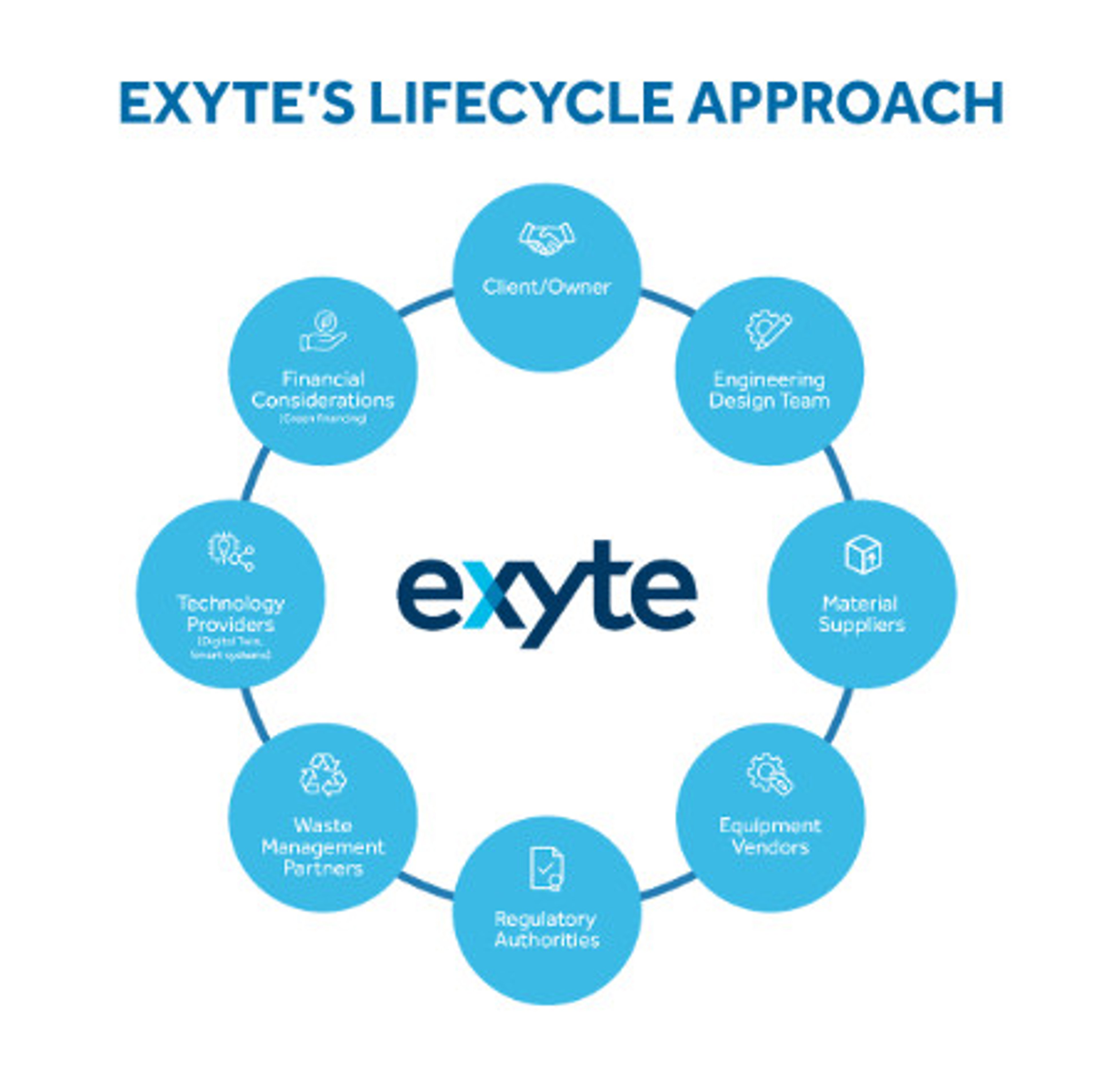
Collaboration: the puzzle pieces of stakeholders
Building a sustainable pharma facility is like completing a complex puzzle, every stakeholder is a piece, and at Exyte, we bring them together to reveal the full picture. Success requires alignment across the full project ecosystem.
Clients and owners: Set sustainability goals and provide investment to drive change.
Engineering and design teams: Integrate embodied carbon, operational efficiency, and circular principles into facility concepts.
Material and equipment suppliers: Provide transparency on embodied carbon and participate in take-back schemes.
Waste management partners: Ensure materials are recovered, recycled, or diverted from landfill.
Technology providers: Deliver digital twins, BIM, and smart systems to track carbon and enable circularity.
Regulatory authorities: Enforce standards that accelerate decarbonization and waste reduction.
Financial partners: Adopt green financing and sustainability-linked loans to incentivize low-carbon projects.
At Exyte, we bring these stakeholders together to form the complete puzzle, bringing energy efficiency, embodied carbon reduction, and circular economy practices. We act as the integrator and facilitator, ensuring no piece of the puzzle is left out.
Exyte’s leadership in pharma sustainability
As pharma and biotech companies advance their sustainability agenda, low-carbon sourcing, embodied carbon reduction, and circular waste strategies are moving to the forefront of facility design. These approaches are not only better for the environment, but they also deliver significant cost savings.
At Exyte, we bring all the pieces of the sustainability puzzle together, recognizing that each stakeholder, from clients and design teams to suppliers and regulators, holds a crucial piece. Our role is to integrate them into a complete, future-ready, sustainable solution.
Contact one of our experts: Find out how Exyte can accelerate your sustainability journey and help put together your puzzle.

Sustainability Manager at Exyte
Padmaja Ekambaram
...