Dresden, Germany
The person everyone called retires
Dresden, Germany
The person everyone called retires
As Karlheinz Quick retires after almost 50 years in industrial construction and three decades working for Exyte at Dresden's semiconductor sites, colleagues are saying farewell to a figure who became part of the region's industrial history. From the early days of semiconductor manufacturing in Dresden through the construction and expansion of a large semiconductor fab campus, he was the person people turned to when sound judgment, and a practical solution were needed.
“It is impossible to put into words what depth of knowledge, and what a remarkable person, will walk out through Gate 1 this afternoon,” Michael Oehme, an Exyte Senior Designer Tool Install at GlobalFoundries, said about his long time colleague Karlheinz Quick, capturing what many people felt that day, Karlheinz's last day on the job. His departure from Exyte and the site is not simply the retirement of a colleague. It marks the farewell of someone who not only accompanied three decades of semiconductor history in Dresden, but helped shape it at decisive moments.
From Dortmund to Dresden
Karlheinz - whose full given name is actually Karl-Heinrich - comes from Dortmund, studied mechanical engineering, and began his career in factory and cleanroom construction in the late 1980s. Before Dresden became the center of his professional life, his work took him to the Netherlands, Italy, Israel, the United States, and to Taiwan, where he was involved in the construction of TSMC Fab 1. Shortly after German reunification, he came to Dresden as a hook-up engineer for a subsidiary of M+W Zander. In September 1997, he began working at today’s GlobalFoundries fab on Wilschdorfer Landstraße, then still AMD. He was there from the very beginning, installed the first tool, and over the following 30 years became a defining presence at a site that itself grew into a symbol of Saxony’s technological awakening.
Within Exyte, and before that at M+W Zander, one of Exyte's predecessor companies, Karlheinz was far more than an experienced specialist. His technical judgment carried weight because it was rooted in decades of experience, technical precision, and an exceptionally clear understanding of the realities on site. More than once, he was sent at short notice to project locations around the world when complex situations needed to be assessed, problems had to be addressed openly, and projects had to be steered back in the right direction, but he always came back to Dresden. What people valued was not only his knowledge, but also his attitude: Karlheinz said what needed to be said – honestly, directly, and constructively. It was precisely this openness that made him a voice people listened to, even at the highest levels of the company.
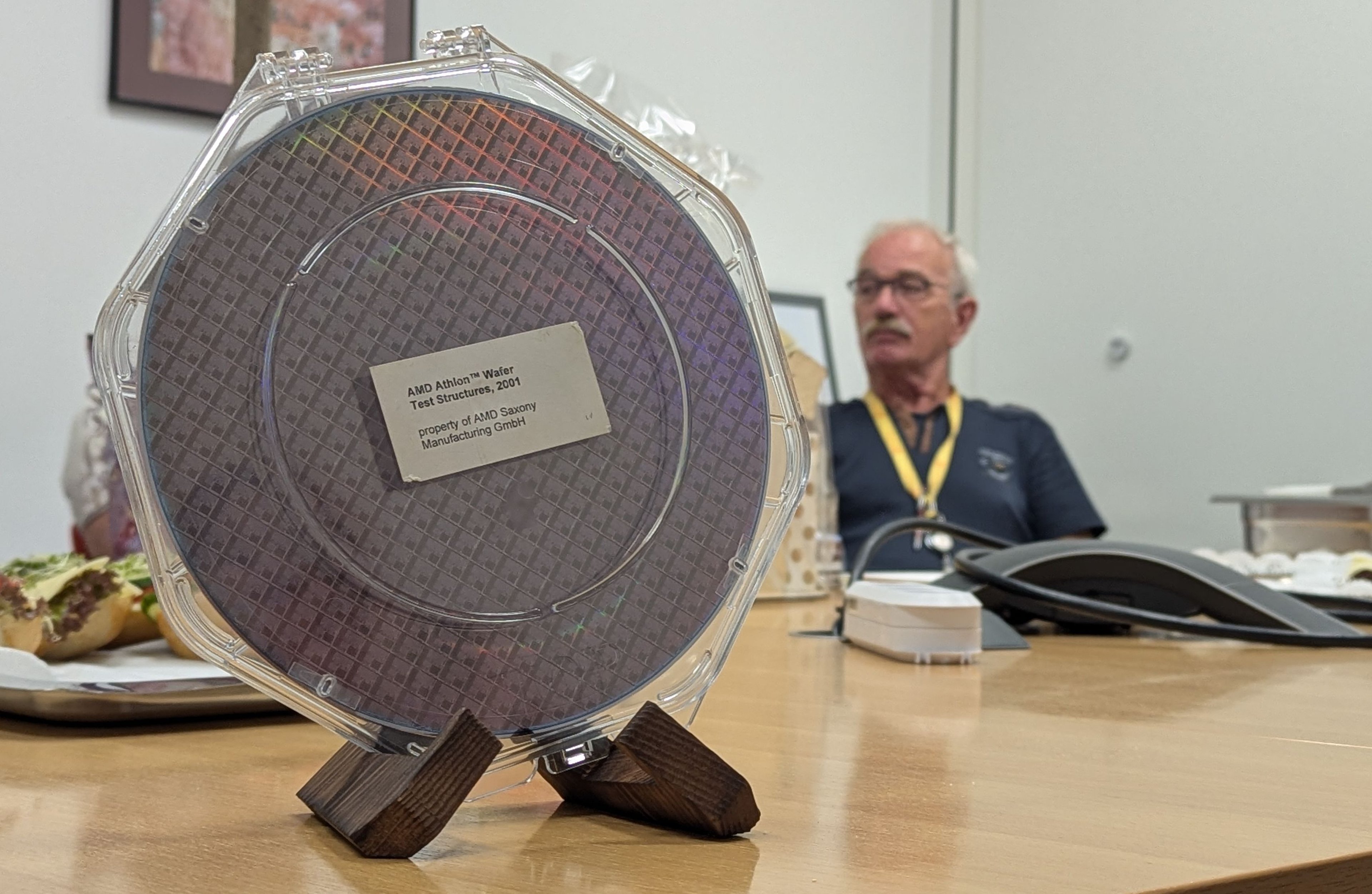
Karlheinz Quick with one of his farewell gifts, a 200 mm wafer from the early years of the fab.
The person everyone called leaves
During his farewell gathering one question came up again and again: “Who are we supposed to call from tomorrow on?” What may sound like a joke at first describes very precisely the role Karlheinz had played for decades. He was a point of contact, a problem-solver, an enabler - and for many, the person you called when it really mattered.On his final day, countless anecdotes made the rounds: of repairs completed faster than anyone expected, of spare parts organized in two hours instead of three weeks, and of situations in which apparent impossibilities somehow became solutions. “In the 1990s, there was a real spirit of optimism here in Dresden. Many international specialists met the motivation of the people in the region. Together, we needed to learn together and built up a network in which people were still willing to help each other even 30 years later.”
Recognition beyond Exyte
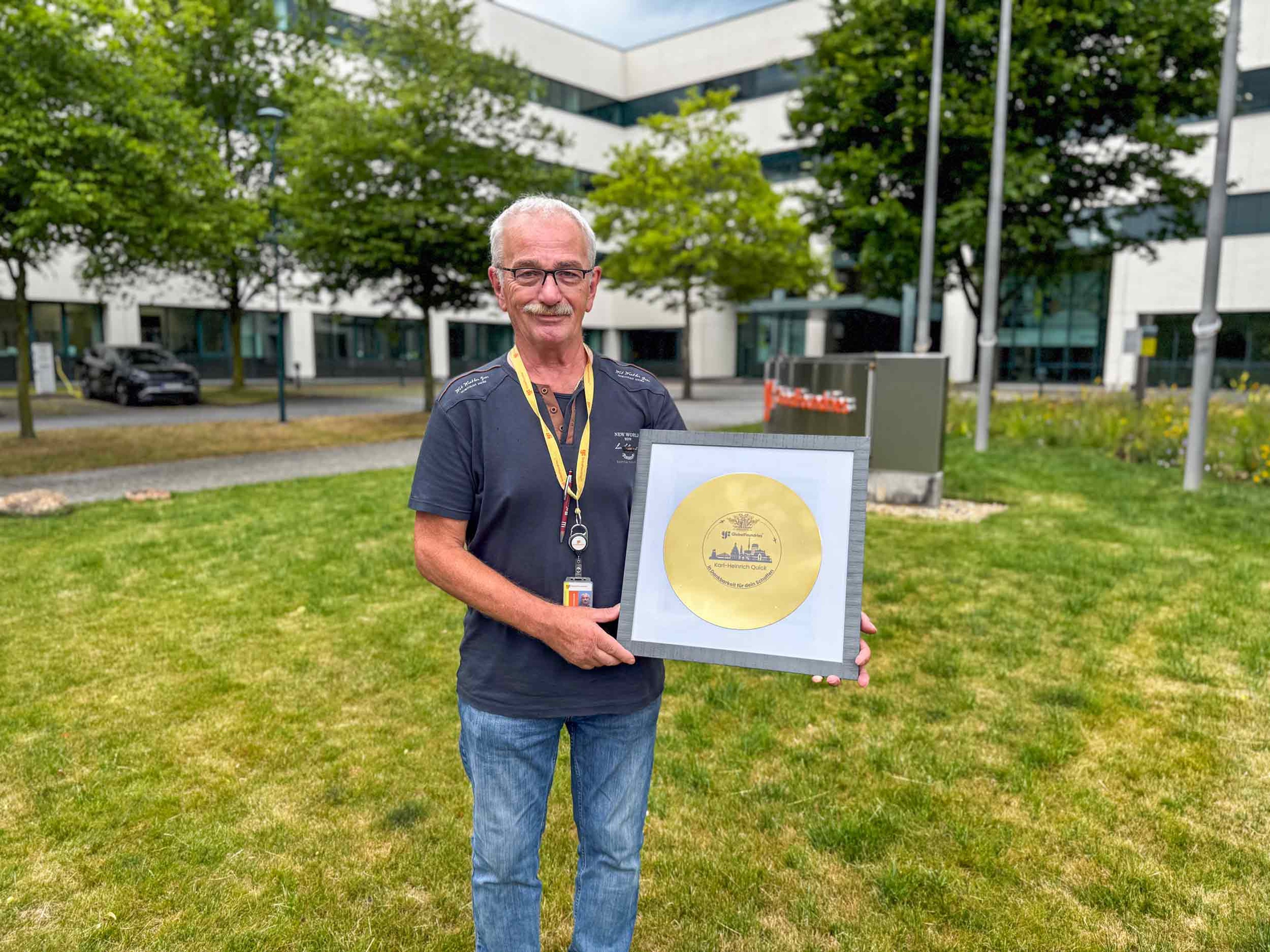
This combination of helpfulness, experience, technical understanding, and an almost legendary instinct for hook-up topics earned Karlheinz respect far beyond his own team. The extent of his significance on the customer side became especially clear on his last working day: representatives of GlobalFoundries presented him with two wafers as a sign of gratitude – a gold-plated 300 mm wafer with a personal dedication, as well as a 200 mm AMD Athlon wafer from the early years of the fab. These were gifts with symbolic power: they stood not only for personal appreciation, but also for a shared history that Karlheinz had helped write over decades.
Alexander Kirstan, Department Director CPM at GlobalFoundries, also made it a point to say farewell to Karlheinz with personal words: “We will miss you, not only as an expert, but especially as a person.”
And so Karlheinz sat in the canteen with his closest colleagues one last time, drank one final chocolate milk, and looked ahead to the future. “I am leaving with one laughing eye and one crying eye. It has been a wonderful time here, and I have truly enjoyed it,” Karlheinz said, reflecting on the past 30 years in Dresden and almost 50 years in industrial construction. So, is this really the end? After having postponed his retirement three times already, Karlheinz is now very sure that he will not be coming back, however much his colleagues might wish otherwise. They do, however, have his private phone number – for a call in case of emergency.